Most Mentoring Is Fake

What are you full of shit about?
She asked me that every week. Not "what challenges are you facing." Not "what's on your mind." That.
The first month I gave her clean reports. Professional, organized, everything's fine. She'd look at me the way you look at a kid who says he didn't eat the chocolate when it's all over his face. She didn't push. She just waited.
She broke me slowly. She just kept showing up and waiting. When I finally stopped performing — when I told her I was terrified that I'd been promoted past my competence, that I was managing a team I didn't know how to manage, that I went home every night and rehearsed conversations I was too afraid to have — she didn't fix me. She said, "Good. Now we can start."
That was mentoring. What I'd been doing for years before her — the calendar slots, the pleasant questions, the conversations where both people leave feeling productive without having said anything true — that was something else.
The New Year's Resolution
I wrote a book about what Eleanor did to me — fictionalized, but the bones are real. These essays go deeper into the same ground.
I ran a mentorship program once. Paired seniors with juniors. Gave them a meeting cadence and a conversation guide. "What are your goals for this quarter?" "What skills do you want to develop?" Safe questions. Clean questions.
It lasted six months. Participation dropped every month. By the end three pairs were still meeting; two of those had become coffee chats about weekend plans. I wrote it up as a success because three pairs finished. I didn't mention that nobody who finished was measurably different from when they started.
You've seen these rooms. The senior engineer who "mentors" by answering Slack questions when he has time. The skip-level 1:1 that's really a status update wearing a nicer title. HR mixes people like kids with their first chemistry set and calls it alchemy when nobody explodes. The learning budget that stays unused because learning isn't the point; compliance is.
None of these cost anything. Companies love quantifying the dollar investment and they'll tell you all about it. But nobody ever has to say "the thing you're avoiding is the thing you need."
Cheap Grace
Dietrich Bonhoeffer — Lutheran pastor, Nazi resistor — was hanged for this. He told the German church that grace without cost was a lie, and it killed him.
Cheap grace, he called it. The version of transformation that lets you feel transformed without transforming. You get the language, the warm feeling of growth, the identity of someone who's doing the work; and you pay nothing for it. The church filled its pews with people who called themselves saved and never changed a thing about how they lived.
Your company offers the same costless grace every quarter and calls it a mentorship program. You get the calendar invite, the conversation guide, the warm feeling of investing in people. Nobody has to bleed for it. Nobody has to change. Bonhoeffer would have recognized it immediately.
The Card
I carry an index card now. Three questions, blue ink.
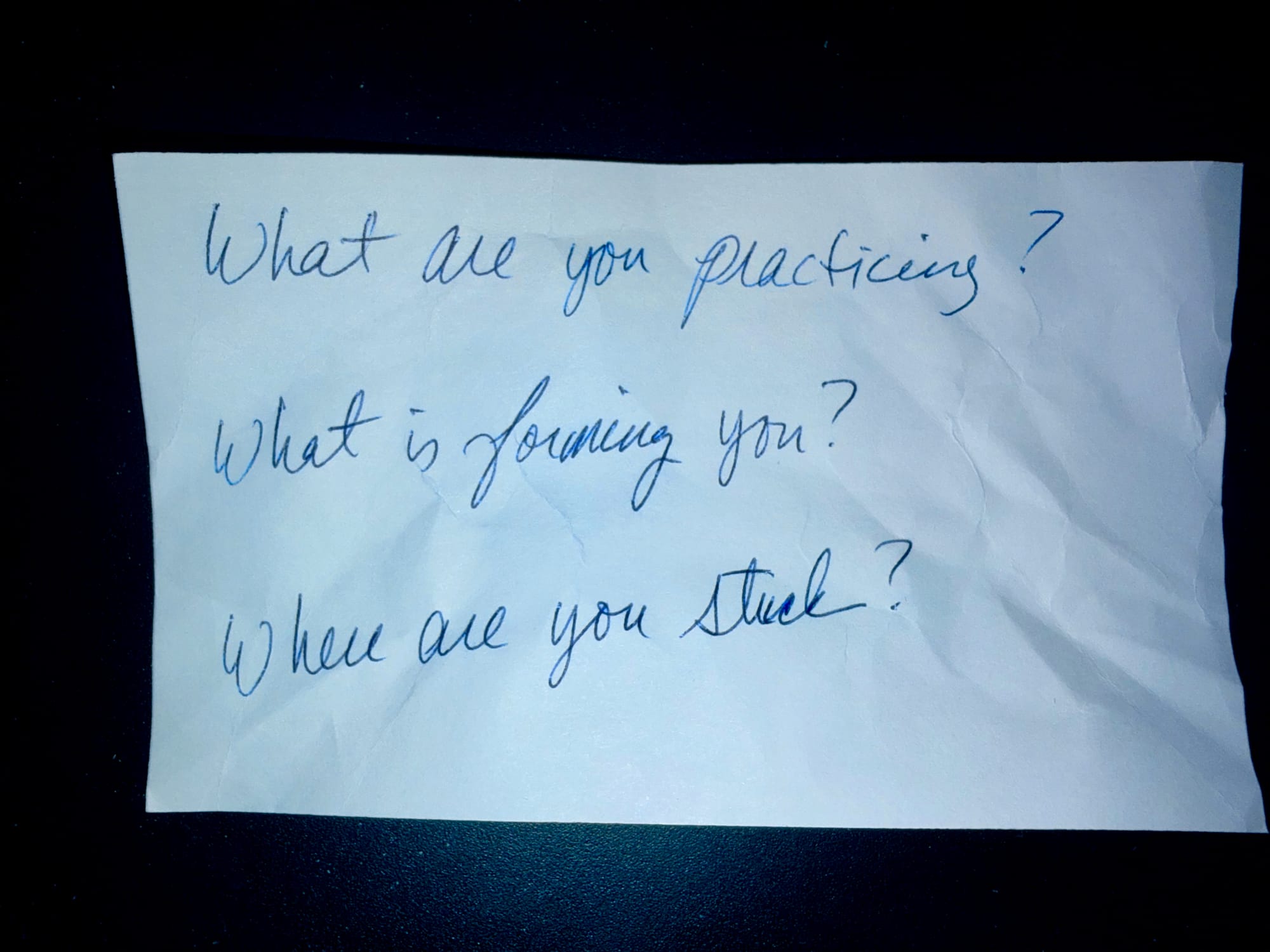
Both of us answer. Every session. That's the part nobody expects — the mentor sits across from you and answers the same three questions. Where am I stuck. What's forming me. What am I practicing. Out loud, to your face, with nowhere to hide.
It takes the same courage Eleanor demanded of me. The same exposure. You're not performing expertise from the safe side of the table; you're admitting, in front of someone who looks up to you, that you don't have it figured out either. The first time you do it your voice shakes. The fiftieth time it's just how you show up.
What would you answer?